Description And Operation: Notes
DESCRIPTION
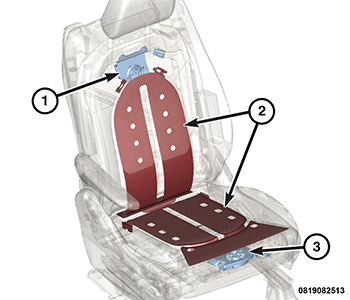
Optional Heated Seats
The Heated Seat System:
- Provides individually controlled, supplemental heat to the seat cushion and seat back surfaces (2), with selectable high and low intensity settings
- Is available for front and second row seating only
- Includes the following primary components:
- Heated seat switches (incorporated into center stack display)
- Heated seat elements (2)
- Seat temperature thermistor sensors
Each heated seat is equipped with one:
- Heating coil integrated into the seat back
- Heating coil integrated into the seat cushion
- Seat temperature sensor located in the seat cushion which:
- Is directly monitored by the Comfort Seat Wheel Module (CSWM)
- Allows the CSWM to determine when to activate or deactivate each heated seat
- All heated seat coils are directly controlled by the CSWM
- Each seat back and seat cushion provide the same heat level and cannot be warmed independently
- When heated, the driver and front passenger seats have three settings, Hi, Low and Off
On the Integrated Center Stack (ICS) display, the heated seats can be controlled by the soft buttons. The ICS broadcasts a CAN-I signal to the CSWM to complete the request.
Remote Start Heated Seats
On models equipped with remote start, the heated steering wheel and heated seats can be programmed to come on automatically during remote start operation in cold weather.
When this feature is selected, the driver's heated seat and heated steering wheel will automatically turn on when temperatures are below 40°F (4.4°C). When temperatures are above 80°F (26.7-°C) the driver vented seat will turn on.
To program the heated steering wheel and seats, select "Settings" from the controls screen, then select "Auto-On Comfort" from the Settings screen, the select the starting option from the Auto-On Comfort screen.
OPERATION
CSWM:
- The CSWM controls the heated seat system.
- The Steering Column Control Module (SCCM) is the interface between the heated steering wheel and the vehicle.
- The Steering Wheel Switch (SWS) converts hard wired sense and return information into a LIN bus message and sends to the SCCM.
- The Body Control Module (BCM) gates messages between the CAN C bus and the CAN I bus. Additionally the BCM provides vehicle information to the CSWM.
Refer to DESCRIPTION AND OPERATION for heated steering wheel information.
Heated Seats:
- The heated seat system operates on battery current received through fused ignition switch output (Run) circuits and will only operate when the engine is running.
- The CSWM directly provides power to the seat heating elements in the seat cushions and seat backs for seat heating.
- The driver seat heat system and passenger seat heat system each consist of a cushion element connected in parallel with a back element.
- A thermistor sensor feedback from each seat heating element to the CSWM is used to regulate the heater outputs to prevent any seats temperature from rising above the set points. If a seat temperature exceeds the set point the CSWM automatically disables the system.
- The high level cutoff value range is from 122 to 140 degrees Fahrenheit in increments of 1 degrees Fahrenheit. The typical value is 129 degrees Fahrenheit.
- The low level cutoff value range is from 122 to 140 degrees Fahrenheit in increments of 1 degrees Fahrenheit. The typical value is 131 degrees Fahrenheit.
- The CSWM will also turn off the heated seat elements if an open or short in the heating element circuit is detected.
- Each time a heated seat request signal is received by the CSWM, the heated seat output will cycle from Off to High, High to Low and Low to Off. (i.e the first press cycles from Off to High, the next press cycles from High to Low and the next press cycles from Low to Off.)
- When the CSWM receives the actuation request, the CSWM activates the heating element output at the high level and transmits a message on the CAN-I bus to indicate the current output state is high.
- The CSWM automatically transitions the output from high to low after a maximum period of 60 minutes has elapsed and transmits a message on the CAN-I bus to indicate the current output state is low.
- The CSWM automatically transitions the output from low to off after a maximum period of 45 minutes has elapsed and transmits a message on the CAN-I bus to indicate the current output state is off.
When pressing the heated seat switch:
- A CAN-I bus message request is generated.
- The CSWM receives the "Heated Seat request" from the CAN-I bus.
- The CSWM broadcasts a confirmation of actuation message over the CAN-I bus.
- The CSWM energizes an integral solid-state relay, which supplies Pulse Width Modulated (PWM) current to the heating elements of the designated seat(s).
- The CSWM monitors the seat temperature.
The CSWM is diagnosed using a scan tool and will automatically turn off the heating elements if it detects an open or low short in a heating element circuit.