Supplemental Restraint System (SRS): Notes
Component Location
Safety Belt System Pretensioners and Inflatable Belts
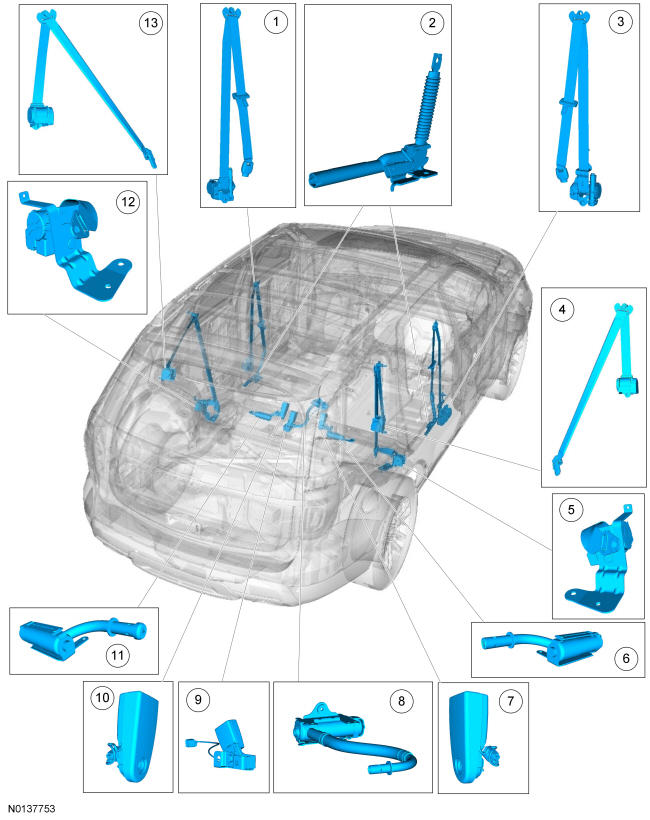
| Item | Part Number | Description |
|---|---|---|
| 1 | 611B09 | Safety belt retractor and pretensioner |
| 2 | 610E44 | Safety belt anchor and pretensioner, RH |
| 3 | 61E45 | Safety belt anchor and pretensioner, LH |
| 4 | 611B08 | Safety belt retractor and pretensioner with adaptive load limiter |
| 5 | 611B68 | Safety belt retractor with inflatable shoulder belt |
| 6 | 611B68 | Safety belt retractor lap belt (part of inflatable safety belt system) |
| 7 | 61202 | Safety belt inflator (40 percent seat) |
| 8 | 60044 | Safety belt buckle (40 percent seat) (part of inflatable safety belt system) |
| 9 | - | Safety belt inflator (60 percent seat) (part of 61203) |
| 10 | - | Safety belt buckle (60 percent seat) (part of inflatable safety belt system) (part of 61203) |
| 11 | 60045 | Safety belt buckle (40 percent seat) (part of inflatable safety belt system) |
| 11 | 61203 | Safety belt inflator (40 percent seat) |
| 12 | 611B69 | Safety belt retractor lap belt (part of inflatable safety belt system) |
| 13 | 611B69 | Safety belt retractor with inflatable shoulder belt |
Supplemental Restraint System (SRS) Deployable Devices
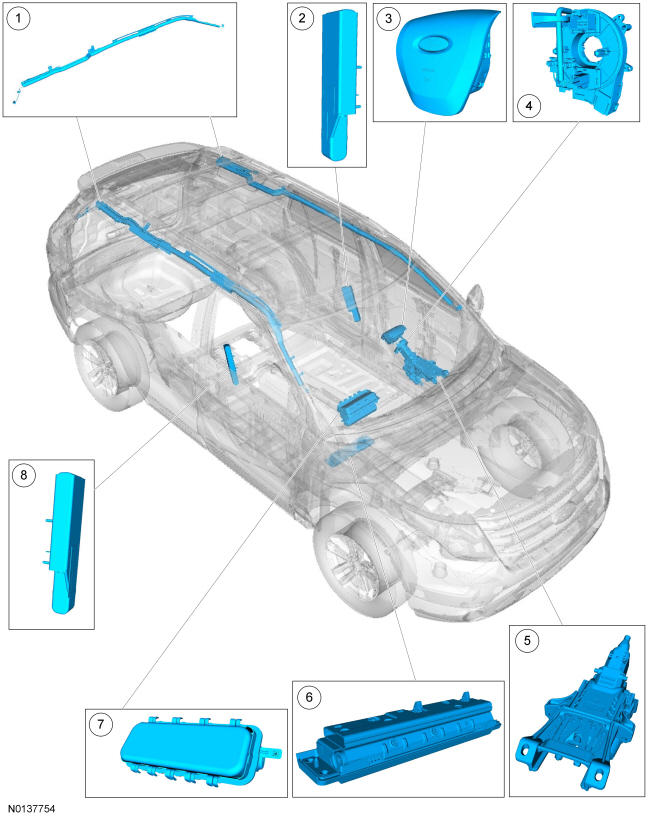
| Item | Part Number | Description |
|---|---|---|
| 1 | 042D94 | Safety Canopy module, RH |
| 2 | 042D95 | Safety Canopy module, LH |
| 3 | 611D11 | Side air bag module |
| 4 | 043B13 | Driver air bag module |
| 5 | 14A664 | Clockspring |
| 6 | 3C529 | Deployable steering column |
| 7 | 045J76 | Knee air bag module |
| 8 | 044A74 | Passenger air bag module |
| 9 | 611D10 | Side air bag module |
Supplemental Restraint System (SRS) Sensors and Indicator
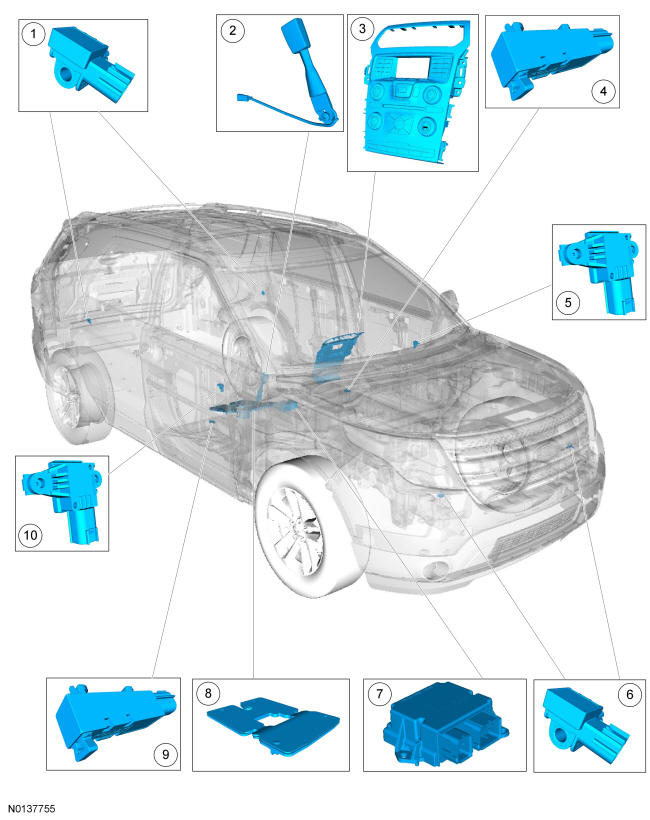
| Item | Part Number | Description |
|---|---|---|
| 1 | 14B345 | C-pillar side impact sensor |
| 2 | 61202 | Passenger safety belt buckle with BTS |
| 3 | - | PAD indicator (part of 18842) |
| 4 | 14B416 | Seat position sensor (driver) |
| 5 | 14B345 | Front door side impact sensor |
| 6 | 14B345 | Front impact severity sensor |
| 7 | 14B321 | RCM |
| 8 | 632A22 | OCS sensor |
| 9 | 14B416 | Front passenger seat position sensor |
| 10 | 14B345 | Front door side impact sensor |
Overview
The Restraints Control Module (RCM) continually receives and monitors inputs from the OCSM and various other hardwired switches and sensors. If the RCM detects a sudden vehicle deceleration and/or lateral deceleration based on the information received from the various sensors, and determines that deployment is necessary, the RCM applies voltage and current to deploy the appropriate Supplemental Restraint System (SRS) components.
System Operation
System Diagram - Supplemental Restraint System (SRS)
System Diagram - Supplemental Restraint System (SRS) Inputs
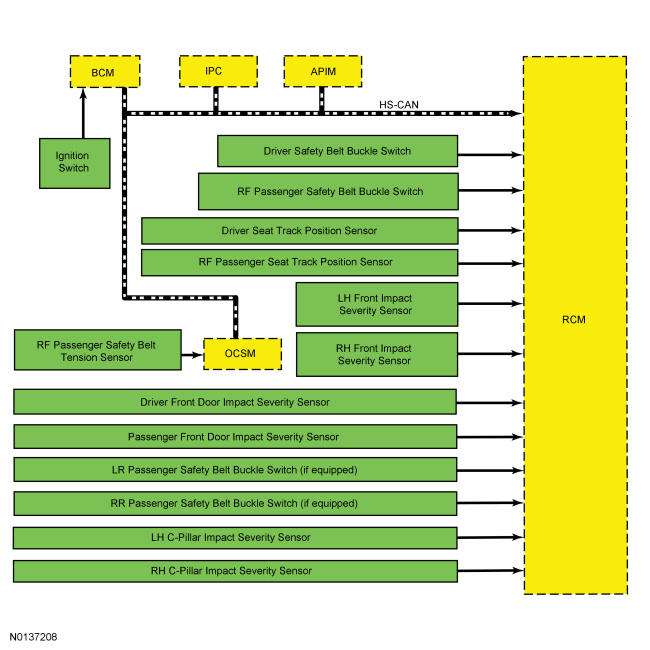
System Diagram - Supplemental Restraint System (SRS) Outputs
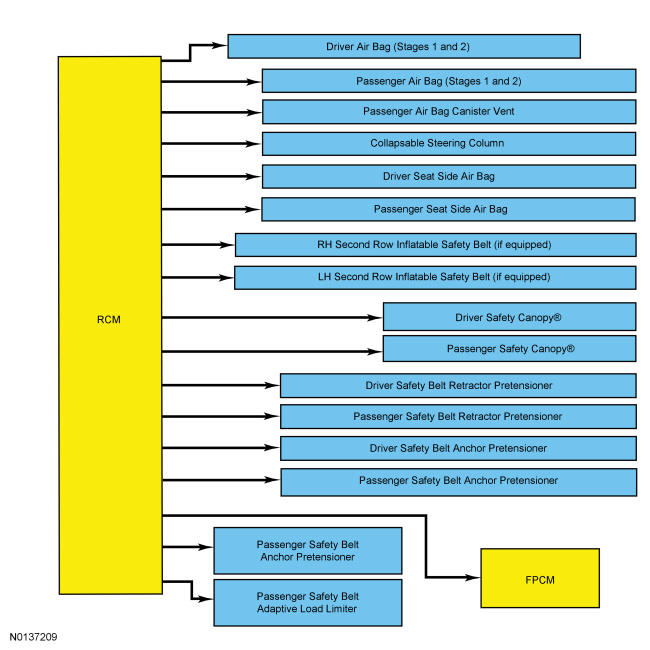
Network Message Chart - Supplemental Restraint System (SRS)
Network Message Chart - Supplemental Restraint System (SRS)
| Broadcast Message | Originating Module | Message Purpose |
|---|---|---|
| Air bag deployment eCall confirmation | APIM | Used for SYNC® 911 Assist operation. Indicates whether eCall notification is in progress after an air bag deployment. |
| Ignition status | BCM-B | Used to qualify certain faults during RCM self-diagnostics. |
| Air bag warning indicator status | IPC | Confirms air bag warning indicator status to the RCM. |
| Passenger air bag indicator status | IPC | Confirms PAD indicator status to the RCM. Indicates a PAD indicator fault, if present. |
| Safety belt warning indicator status | IPC | Confirms safety belt warning indicator status to the RCM. |
| Safety belt warning chime status | IPC | Confirms safety belt warning chime status to the RCM. |
| OCS calibration data | OCSM | Shares application-specific data for comparison purposes to make sure the correct OCSM and RCM are installed. |
| OCS fault status | OCSM | Indicates an OCS fault, if present. |
| OCS sensor data | OCSM | OCS sensor readings. |
| OCS serial number | OCSM | OCSM serial number. |
System Diagram - OCS
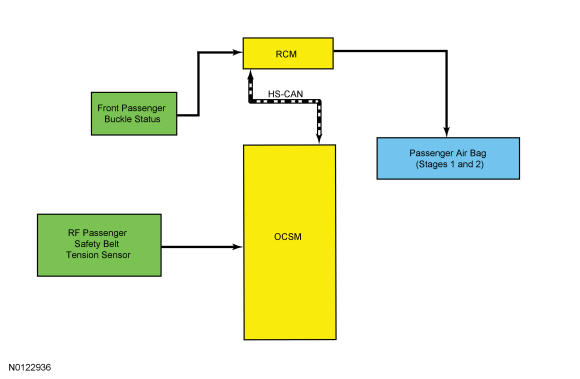
Network Message Chart - OCS
| Broadcast Message | Originating Module | Message Purpose |
|---|---|---|
| Passenger safety belt buckle status | RCM | Used for determining passenger air bag module disable status. |
| RCM serial number | RCM | RCM serial number. |
Supplemental Restraint System (SRS)
The Supplemental Restraint System (SRS) is controlled by the RCM, which continually monitors various inputs. When these inputs indicate a frontal or side crash, the RCM may deploy some components, based upon the severity of the crash and the sensor inputs. Refer to Supplemental Restraint System (SRS) , System Diagram - Supplemental Restraint System (SRS) to view the Supplemental Restraint System (SRS) inputs and outputs.
Although some deployable devices may not have activated for all occupants during a crash, it does not mean that something is wrong with the Supplemental Restraint System (SRS).
The RCM performs a self-test of the complete Supplemental Restraint System (SRS) during each startup. During normal operation, the IPC illuminates the air bag warning indicator continuously for 6 seconds. If the Supplemental Restraint System (SRS) is free of faults, the air bag warning indicator turns off and remains off. If a Supplemental Restraint System (SRS) fault exists, the air bag warning indicator illuminates and remains illuminated for the rest of the ignition cycle. The RCM communicates to the IPC via the HS-CAN. The IPC illuminates the air bag warning indicator based on messaging from the RCM or if there is no communication between the RCM and IPC. In addition to the self-test at start up, the RCM continuously monitors all of its Supplemental Restraint System (SRS) components and circuitry for correct operation.
Air Bag Module Second Stage Deployment Check
The driver and passenger front air bags each have 2 deployment stages. After an air bag module deployment, it is possible that stage 1 has deployed and stage 2 has not. If a front air bag module has deployed, the front air bag module must be remotely deployed using the appropriate air bag disposal procedure. For information on driver air bag module and/or passenger air bag module remote deployment, Refer to Pyrotechnic Device Disposal .
Air Bag Warning Indicator
The air bag warning indicator:
- is located in the IPC and proves out by lighting for 6 seconds and then turning off.
- flashes and/or illuminates based on the message that the IPC receives from the RCM.
- illuminates if the IPC does not receive a message from the RCM.
Event Notification Signal
The purpose of the event notification feature is to provide other vehicle subsystems with information pertaining to restraint system deployment or fuel cutoff status. Signal communication between the RCM and fuel pump control module allows the PCM to initiate fuel cut-off to disable the fuel system in the event of a crash.
OCS
The OCS is found only on the front passenger seat. The OCS classifies the size of the front passenger seat occupant and provides this information to the RCM. The RCM uses this information (and other inputs) in determining the deployment strategy of the passenger air bag, adaptive load limiter, and passenger seat side air bag and pretensioners. The OCS is comprised of:
- a silicone gel-filled bladder mounted between the seat cushion foam and seat pan
- an OCSM with an integrated pressure sensor, attached to the seat frame
- a BTS, which is hard-wired to the OCSM
Pressure is applied to the OCS bladder when weight of any occupant or object in the front passenger seat is present. The pressure is then transferred through a tube and sensed by the OCS pressure sensor within the OCSM. The OCSM and pressure sensor is mounted to a bracket underneath the seat cushion pan and is serviced as a kit with the seat cushion and heater mat (if equipped). The OCSM sends information concerning the weight of any occupant or object on the front passenger seat to the RCM via the HS-CAN. The RCM uses this information when determining if the passenger air bag module needs to be deployed in the event of a crash.
The OCS is also used for operation of the passenger Belt-Minder®. For information on the passenger Belt-Minder® feature, REFER to Safety Belt System - 1st Row, Belt-Minder. To deactivate or reactivate the passenger Belt-Minder® feature, REFER to Instrumentation, Message Center, and Warning Chimes or the Owner's Literature.
PAD Indicator
The RCM controls the state of the PAD indicator via the HS-CAN and I-CAN. The PAD indicator state is based on information that the OCS provides to the RCM. When the passenger air bag is activated, the PAD displays ON. If the RCM has deactivated the passenger air bag, the PAD indicator displays OFF.
The RCM briefly activates the PAD indicator to prove out the indicator function and verify proper functional operation of the PAD indicator to the front occupants.
The following table indicates the passenger air bag and PAD indicator status based on the size of the front passenger occupant.
Supplemental Restraint System (SRS)
| Occupant Size | Passenger Safety Belt Buckle Status | Passenger Air Bag Status | PAD Indicator Status |
|---|---|---|---|
| Empty | Buckled or Unbuckled | Disabled | OFF: Lit |
| ON: Unlit | |||
| Small | Buckled or Unbuckled | Disabled | OFF: Lit |
| ON: Unlit | |||
| Large | Buckled or Unbuckled | Enabled | OFF: Unlit |
| ON: Lit |
Inflatable Safety Belts (if equipped)
REFER to Safety Belt System , System Operation.
Secondary Air Bag Warning (Chime)
The secondary air bag warning chime is an audible chime located in and controlled by the IPC. If a fault is detected with the air bag warning indicator, a DTC is stored in memory of the IPC. Upon receiving the message from the RCM that a Supplemental Restraint System (SRS) fault has been detected, the IPC sounds the secondary air bag warning chime in a pattern of 5 sets of 5 beeps.
SOS Post-Crash Alert System™
The SOS Post-Crash Alert System™ is a system that is controlled by the BCM-B but initiated by the Restraints Control Module.
When a deployment event occurs, the RCM sends a message on the HS-CAN to the BCM-B. The BCM-B flashes the turn signal lamps and sound the horn until it is turned off. For information about the SOS Post-Crash Alert System™, REFER to Multifunction Electronic Modules , Post Crash Alert Function.