Thermo-Electric Device (TED) Cooling Performance
Component Test
NOTE:
This test is intended to check the cooling mode performance of an operational climate controlled seat backrest or cushion TED and verify it is cooling inlet air at the TED (ambient cabin air) between 6-8 ° C (10-14 ° F).
NOTE:
Make sure the vehicle is out of direct sunlight and is in an area with a stable air temperature when testing the climate controlled seat system.
NOTE:
For correct temperature measurements, the seat being tested should be occupied.
- 1.
Enter DataLogger and monitor the following DCSM PIDs :- Seat cushion TED temperature (CSHTEMP)
- Seat back TED temperature (BK_TEMP)
- Passenger cushion TED temperature (PCSHTMP)
- Passenger back TED temperature (PBKTMP)
- Driver state seat mode (DCCSMOD)
- Passenger state seat mode (PCCSMOD)
- 2.
Any initial PID value of greater than 205 ° C (401 ° F) or less than 2 ° C (36 ° F) indicates a system hardware failure. Do not proceed with this test. Refer to Symptom Chart: Seating - Climate Controlled or Refer to Seating .
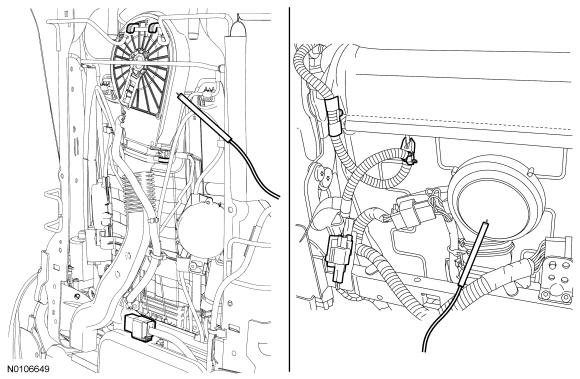
- 3.
Gain access to the seat backrest and cushion TEDs and use a suitable thermocouple temperature measuring device to monitor the air inlet temperature.- Detach the backrest cover lower J-clips and route the wire harness(es) and manual lumbar cable (if equipped) out of the holes in the backrest cover.
- On each side, separate the backrest cover clip and hook-and-loop strips.
- Separate the hook-and-loop strips, invert the backrest cover up and remove the first row hog rings.
- Separate the hook-and-loop strips, invert the backrest cover up as far as it will go.
NOTE:
Typical backrest and cushion TED shown, others similar.
- 4.
Operate system in high cool mode and measure the temperature at the cushion TED filter using the thermocouple device.- Obtain and record the air inlet temperature at the TED.
NOTE:
The engine must be running to operate the climate controlled seat system and carry out this test.
- 5.
Use a diagnostic scan tool to measure the cushion TED PID temperature and record the value.- Monitor the MODE PID and verify the system is operating. If during testing the PID value changes to Blower Only state, the system has entered into recovery mode and voltage to the TEDs is disabled. If this occurs, the seat has failed the test. Do not continue. Return to the diagnostic routine.
- 6.
Subtract the cushion TED PID temperature from the cushion air inlet temperature and record the temperature difference value.
- 7.
Continue to operate the system in high cool mode and use the thermocouple device to measure the temperature at the backrest TED filter.
- 8.
Use a diagnostic scan tool to measure the backrest TED PID temperature and record the value.- Monitor the MODE PID and verify the system is operating. If during testing the PID value changes to Blower Only state, the system has entered into recovery mode and voltage to the TEDs is disabled. If this occurs, the seat has failed the test. Do not continue. Return to the diagnostic routine.
- 9.
Subtract the backrest TED PID temperature from the backrest air inlet temperature and record the value.
- 10.
Compare the cushion and backrest calculated temperature values. The temperature difference should be between 6 and 8 degrees.
- 11.
If the calculated temperature values are not within these specifications, check the climate controlled seat components for air duct or filter restrictions, blockages, duct or electrical disconnections and for incorrect assembly. Repair as needed. If OK, carry out the DCSM self-test and if any DTCs is retrieved, Refer to Seating . Return to the diagnostic routine.